Technology
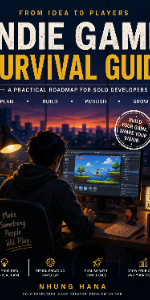
Indie Game Survival Guide
by Nhung Hana
EN2026-04-252.00 USD
There is a quiet dream that many developers carry with them, often without saying it out loud. The idea of building a game. Not just playing one, not just imagining one, but creating something that exists, something people can interact with, something that came entirely from their own mind. It starts small, sometimes as a passing thought, sometimes as a strong vision, but for most, it never becomes real. Not because the idea was not good enough, not because the tools were unavailable, but because the path from idea to finished game is filled with uncertainty.
This book exists for that exact reason.
Indie Game Survival Guide is not a collection of theories, and it is not a step-by-step technical manual. It is a structured journey. A way of thinking. A practical mindset designed for one type of creator: the solo developer. The one who does not have a team, does not have unlimited resources, and cannot afford to waste time building the wrong things. If that sounds like you, then you are exactly where you need to be.
What you will not find here is the illusion of perfection. You will not be told to build the next massive open-world game or chase unrealistic standards. Instead, you will learn how to build something real, something focused, something that works. You will learn how to take a simple idea, refine it, turn it into a playable experience, and guide it through every stage from creation to release and beyond. This book is not about building the biggest game. It is about building a finished one.
Throughout these chapters, you will move through a complete cycle. You will start with an idea and learn how to filter it, reduce it, and shape it into something you can actually build. You will understand how to think like a one-person studio, how to manage your energy, your time, and your decisions. You will build your first playable version, not to impress, but to learn. You will refine gameplay, visuals, sound, and user experience with one clear goal: clarity and engagement. And when your game is ready, you will take it further. You will publish it, present it, and learn how to bring it to players without losing what made it valuable in the first place.
But this book goes beyond building.
Because the hardest part of this journey is not starting, and it is not even finishing. It is continuing. It is staying consistent when progress slows, adapting when things do not work, and moving forward without waiting for perfect conditions. That is why survival is at the core of this guide. Not survival in the sense of struggle, but survival in the sense of persistence. The ability to keep creating, to keep improving, to keep building again and again.
You will make mistakes. That is expected. You will face moments where your game does not feel as exciting as it once did. That is normal. You will question your decisions, your direction, and sometimes even your ability. That is part of the process. What matters is not avoiding these moments, but learning how to move through them. Every chapter in this book is designed to give you that ability. Not by removing difficulty, but by giving you a clear way to handle it.
So as you begin reading, I want you to shift your perspective. You are not here to learn how to make a perfect game. You are here to learn how to make a real one. A game that exists, that can be played, that can be improved. And more importantly, you are here to become someone who can repeat that process. Someone who does not just have ideas, but knows how to bring them to life.
This is your starting point.
Not the moment you had the idea, but the moment you decided to act on it.